XR Changeover Training for Industrial Line Ramp-Up

Can XR changeover training help industrial teams ramp up faster when every minute of line downtime matters?
Production changeovers are where planning, maintenance, quality, safety, and frontline confidence all collide. A new product variant, tooling swap, recipe update, or packaging format can look simple in a document, yet still create hesitation on the floor when operators need to move quickly and precisely. Mimic Industrial approaches that moment as a live performance problem: the team should be able to rehearse the work, understand the equipment context, and arrive at the line already aligned.
That is why XR changeover training is becoming a valuable layer in modern industrial operations. By combining immersive rehearsal, asset-anchored guidance, digital twins, AI-assisted coaching, and measurable learning data, factories can turn high-pressure transitions into repeatable routines. The result is less tribal knowledge, fewer avoidable mistakes, and a clearer path from engineering intent to stable production.
Table of Contents
Why Changeovers Put Industrial Teams Under Pressure

Changeovers expose the small gaps that ordinary production can hide. A technician may know how a machine behaves during steady-state operation but still be unsure about the exact order for tooling removal, calibration, validation, cleaning, or safety checks. A supervisor may have the SOP, but not the spatial context of where each task happens or which decision points usually slow the crew down.
In many plants, those details live in experienced workers rather than in a training system. That makes ramp-up vulnerable whenever a new shift, new site, or new product format enters the picture. A written SOP helps, but it does not always show body position, line-of-sight, clearance, handoff timing, or the real consequences of a skipped step.
XR changeover training gives teams a place to practice the transition before the line is stopped. In a custom VR or AR training module, operators can rehearse the sequence, maintenance teams can confirm access points, and managers can see where confusion appears before it becomes downtime.
Operators learn the new sequence before the changeover window opens.
Maintenance teams can rehearse tooling, adjustment, and reset tasks without blocking production.
Quality teams can embed inspection checkpoints into the same guided workflow.
Safety leaders can confirm lockout, cleaning, guarding, and restart behaviors before live execution.
How XR Changeover Training Works Before the Line Stops
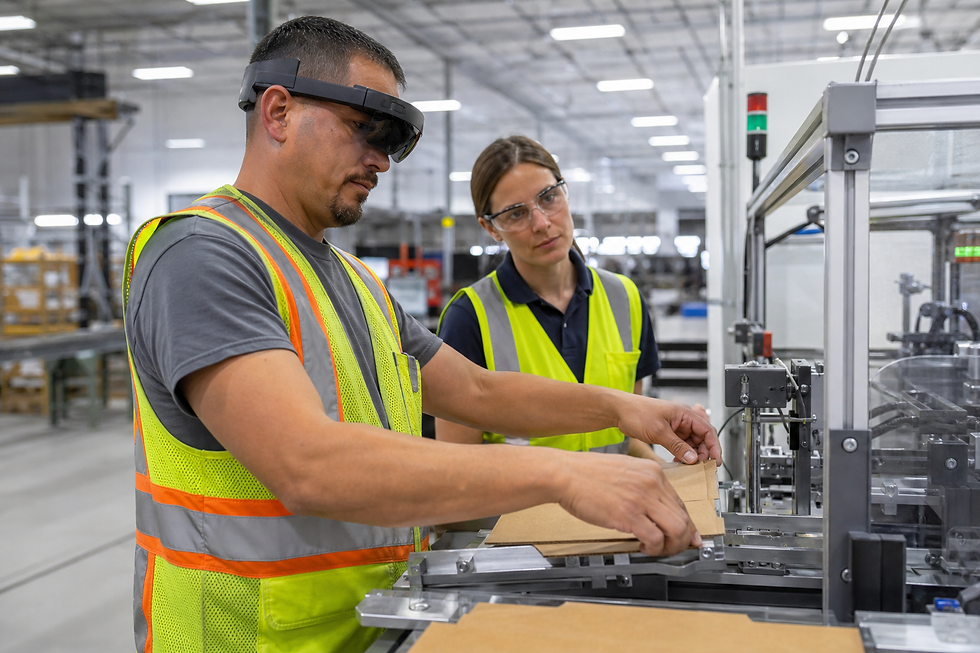
A strong XR changeover program starts with the real workflow, not with a generic simulation. The team maps the equipment, the product transition, the tools, the inspection criteria, the expected timing, and the hazards. Then the experience turns that knowledge into a repeatable training path that can be practiced in VR, reviewed on desktop, or delivered as AR guidance near the physical asset.
Mimic Industrial combines simulation design, 3D scanning and motion capture technology, and industrial-grade visualization to recreate the work in a way that feels practical rather than theatrical. The aim is not to impress workers with a futuristic demo; the aim is to help them know exactly what to do when the line is under time pressure.
A useful module also respects the way industrial teams actually learn. Some workers need a full immersive rehearsal before they touch the machine. Others need a short refresher on the morning of the changeover. Supervisors may need a quick view of who has completed practice and where the crew still needs coaching. A custom program can support all three without forcing every role into the same training format.
Before the changeover, operators can run through the sequence. During training, they can make mistakes without damaging equipment, delaying production, or creating risk. Supervisors can identify where the SOP needs better language, where tooling should be staged differently, or where two roles are likely to wait on each other.
This rehearsal also improves communication between engineering and operations. Engineers can show the intended setup logic; frontline teams can flag what does not match the actual floor; training designers can update the module so the next crew practices the improved version.
Turning SOPs Into Spatial Guidance During Ramp-Up
The real value of XR appears when SOPs stop being static documents and become contextual guidance. During ramp-up, an operator may not need a 40-page procedure. They need the right step, in the right place, at the right moment, with enough visual context to act confidently.
AR can anchor instructions to the physical asset, while a connected worker workflow can keep the sequence consistent across shifts and facilities. This complements the site's work around industrial AI avatars, which can answer procedural questions, reinforce safety checks, or explain why a step matters instead of only telling a worker what to click next.
For changeovers, spatial guidance is especially useful because many tasks are location-specific. A valve, sensor, jig, guard, fastening pattern, recipe parameter, or inspection point may be easy to describe in a manual but hard to find quickly under pressure. AR reduces the distance between instruction and action.
This does not replace experienced workers. It protects their expertise by turning it into repeatable guidance. When the strongest crew knows a faster setup order or a safer inspection habit, that knowledge can be captured in the XR workflow and transferred to new shifts, new sites, and new product launches. The same thinking supports Mimic Industrial's broader blog guidance on connected workers, remote expert support, and industrial XR teams.
Show the next adjustment point directly on or near the equipment.
Confirm cleaning, guarding, or calibration steps before restart.
Give new workers the same sequence that experienced crews already follow.
Capture completion evidence for quality, safety, and continuous improvement reviews.
Using Digital Twins To Validate Readiness

A changeover is not only a training event. It is also a readiness test. If the new setup changes workflow timing, machine behavior, operator movement, material flow, or inspection requirements, the team needs to see those dependencies before the physical line is committed.
That is where digital twin simulation strengthens XR training. A digital twin can represent equipment, layout, process logic, and operational context. When paired with immersive visualization, teams can walk through the transition, review bottlenecks, and test scenarios that would be too costly to explore during live production.
For example, a packaging changeover may reveal that tools are staged too far from the adjustment point. A product variant may require an extra quality check that disrupts takt time. A maintenance procedure may be safe in isolation but awkward when two roles must share access space. Digital twin review helps surface those issues early.
The training module then becomes more than a learning experience. It becomes a feedback loop between planning, simulation, frontline practice, and operational improvement.
For organizations exploring a wider spatial operating model, this readiness layer can also connect to virtual collaboration environments and Mimicverse-style industrial experiences. Engineers, trainers, and plant leaders can review a shared environment, agree on the preferred changeover path, then convert that approved workflow into training and live guidance.
Measuring Skills, Safety, And Downtime Reduction

Industrial leaders do not adopt XR because it looks novel. They adopt it when it changes measurable outcomes. For changeovers, the most useful measures are practical: time to stable production, number of restart issues, first-pass quality, safety checklist completion, help requests, rework, and worker confidence.
XR training can capture whether a worker completed a sequence, where they paused, which steps needed hints, and whether they respected the safety logic of the procedure. That creates a stronger skills record than a classroom sign-in sheet. It also gives training managers evidence for who is ready to perform the changeover, who needs support, and which part of the procedure is creating friction.
For multi-site organizations across manufacturing, energy, construction, oil and refinery, healthcare, and supply chain, the measurement layer matters even more. A changeover that works well at one site can be turned into a repeatable training asset for another site, while local feedback can keep the workflow improving.
The best programs treat XR as part of an operating system for skill transfer. VR builds muscle memory before live work. AR supports precision during ramp-up. Digital twins validate the environment. AI avatars and digital assistants make procedural knowledge easier to access. Together, those layers help teams move faster without making safety or quality negotiable.
That blend of human expertise and intelligent simulation is central to Mimic Industrial's approach. The goal is not to automate people out of the process. It is to give industrial teams clearer information, better rehearsal, and more confidence when the work becomes complex.
FAQ
What is XR changeover training?
XR changeover training uses virtual reality, augmented reality, and simulation to help industrial teams practice product, tooling, recipe, or process transitions before and during live production ramp-up.
How is XR changeover training different from normal SOP training?
Normal SOP training often relies on documents, videos, or classroom review. XR adds spatial context, interactive practice, equipment realism, and performance tracking so workers can rehearse the actual sequence.
Which teams benefit most from XR changeover training?
Operators, maintenance technicians, quality teams, safety managers, engineers, and supervisors all benefit because changeovers require coordinated action across roles.
Can XR reduce production downtime during changeovers?
Yes, when it is built around the real workflow. XR can reduce hesitation, improve setup accuracy, reveal planning gaps, and help teams reach stable production faster.
Does a factory need a full digital twin before starting?
No. A focused XR module can start with a specific machine, station, or workflow. Digital twin integration can be added when the team wants deeper scenario testing and readiness validation.
Can AR guidance be used on the live production floor?
Yes, AR can support live ramp-up when devices, safety rules, and plant policies allow it. Many teams use VR for rehearsal and AR for task guidance near the equipment.
How does Mimic Industrial create realistic training content?
Mimic Industrial combines simulation, 3D scanning, motion capture, AI systems, and cinematic 3D production to build industrial experiences that are both technically useful and visually clear.
What should companies measure after launching XR changeover training?
Useful metrics include changeover duration, first-pass quality, restart issues, safety completion, number of support calls, trainee confidence, and the steps where workers most often need help.
Conclusion
XR changeover training gives industrial teams a better way to prepare for the moments when downtime is expensive and accuracy matters. Instead of depending only on documents or informal knowledge transfer, teams can rehearse the work, validate the line, follow spatial guidance, and measure readiness before production is under pressure.
For manufacturers and industrial operators, this is a practical path toward safer, faster ramp-up. Explore Mimic Industrial's immersive training and digital twin services to see how custom XR modules, AI avatars, and simulation workflows can turn complex changeovers into repeatable industrial performance.


Comments